

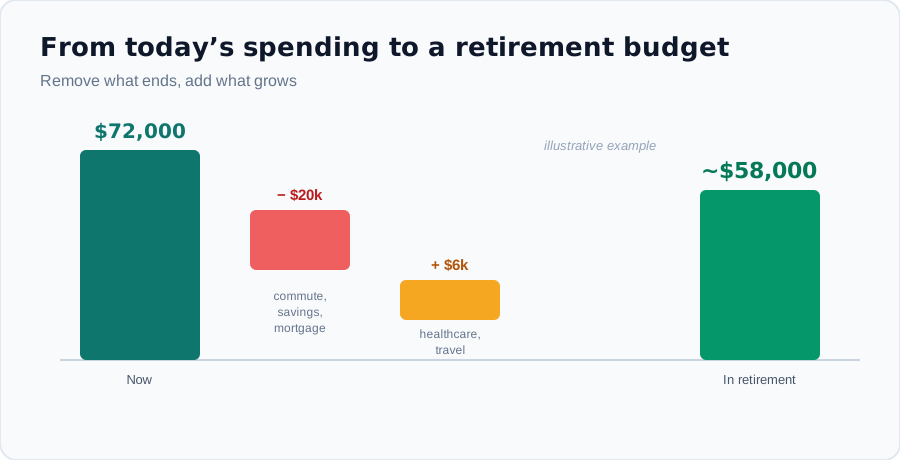
You will often see 70–85% of pre-retirement income used as a retirement spending shortcut, but that range is a starting point, not your number. The reliable way to estimate a retirement budget is to build it from real categories: take your spending today, drop the costs that disappear (commuting, retirement-account contributions, the mortgage if it’s paid off), and add the ones that grow (healthcare, travel in the early years). For a household spending $72,000 now, that often lands somewhere around $55,000–$62,000 in retirement — and that figure drives everything else in your plan.
Your budget is the most important input to any retirement calculation. Every $10,000 of annual spending changes the portfolio you need by about $250,000, so a careful estimate is worth more than a fancy projection. Here’s how to build one.
Why a flat percentage isn’t enough
The 70–85% replacement range is only a shortcut. Some costs end at retirement: you stop saving for retirement, payroll taxes on wages disappear, commuting and work expenses fall, and many people have paid off their mortgage. But the range is wide for a reason — a paid-off house with modest travel plans might need 65%, while an active early retirement with a lot of travel and a mortgage could need 90% or more. Building from categories tells you which end you land on.
Build it from categories
Work through these buckets using your actual numbers:
| Category | Usually in retirement… |
|---|---|
| Housing (mortgage, rent, taxes, upkeep) | Often lower once a mortgage is paid off; taxes and upkeep continue |
| Healthcare & insurance | Higher, and rises with age |
| Food & daily living | Roughly the same |
| Transportation & commuting | Lower — no commute |
| Travel & hobbies | Higher in the active early years |
| Retirement contributions & payroll tax | Gone |
Don’t underestimate healthcare
Healthcare is the category people miss most. Medicare begins at 65 but is not free — Part B carries a monthly premium and deductibles, and total healthcare costs can vary heavily by state, plan, income, and prescriptions. You may also add Part D and a supplement. If you retire before 65, budget separately for marketplace (ACA) coverage in the gap years; the early-retirement healthcare-before-Medicare guide covers that bridge in detail.
Spending isn’t flat — it has a shape
Retirement researchers often describe a “retirement spending smile”: spending can be higher in the active early years, dip in the middle as people slow down, then tick up late from healthcare. A single flat number is a fine planning baseline, but expect to spend more in your 60s and on healthcare later — and to adjust as you go.
Common budgeting mistakes
- Using gross income instead of spending. Your budget is what you spend, not what you earn — most people spend well below their gross pay.
- Forgetting taxes on withdrawals. Money pulled from a traditional 401(k) or IRA is taxable income, so budget on an after-tax basis.
- Ignoring inflation. A $58,000 budget today will cost noticeably more in 20 years; good plans grow the budget with inflation.
- Treating it as fixed. Revisit the budget yearly — flexibility in down markets is one of the strongest protections against running out.
Frequently asked questions
What percentage of income do I need in retirement?
Commonly 70–85% of pre-retirement income, but build from categories to find your real figure. Lower-spending, mortgage-free households can need less; active early retirees can need more.
How much should I budget for healthcare?
It varies widely by coverage and health, but it is consistently one of the largest and fastest-growing line items. Always budget Medicare premiums and out-of-pocket costs separately rather than folding them into a vague total, and check current figures at Medicare.gov.
What to read next
This article is educational and not financial advice. Replacement-rate ranges and the spending-smile pattern are general findings; your budget depends on your housing, health, and lifestyle. Verify Medicare and tax figures with official sources before relying on them.