

Total net worth counts all of your assets minus all of your debts. Liquid net worth focuses on the part you can reach quickly — cash and bank balances, minus the short-term debts most likely to demand fast repayment. The two numbers can be far apart. A homeowner can have a total net worth of $120,000 but a liquid net worth of only $18,000, because most of the wealth is locked inside a home and car. That gap is exactly what decides how you handle an emergency, a job loss, or a sudden opportunity.
If you are still new to the basic formula, start with what is net worth. This article is about the layer most people miss: how usable your wealth really is.
Total net worth, defined
Total net worth is the headline number: every asset you own minus every debt you owe. It includes your home, your car, your retirement accounts, and your cash. It is the right number for tracking long-term progress, but it treats a dollar of home equity the same as a dollar in checking — even though only one of them can pay this month’s bills.
Liquid net worth, defined
Liquid net worth answers a narrower question: how much could you actually get your hands on quickly? It starts with your liquid assets — cash and bank balances — and subtracts short-term, high-interest debt like credit cards. It deliberately ignores assets you would have to sell a home, total a 401(k), or trigger taxes to access.
Why definitions of liquid net worth vary
There is no single official definition, so sources differ — and that is fine as long as you know which one you are using:
- Strict cash view (what Worth101 uses): liquid assets are cash and bank balances only, minus short-term debt.
- Broader marketable-securities view: some sources also treat a taxable brokerage account as liquid, since stocks and ETFs can be sold within days.
- All-debt view: a few definitions subtract every liability, including the mortgage, from liquid assets — which can push liquid net worth negative even for a financially healthy household.
Worth101 reports a liquid net worth estimate using the strict cash view, because it answers the most practical question: what could you cover this week without selling investments or borrowing? The exact rule is in the methodology of how Worth101 defines liquid net worth.
What usually counts as liquid
- Cash and checking
- Savings and high-yield savings (HYSA)
- Money market accounts
- CDs (though early withdrawal may cost a penalty)
What usually does not count as liquid
- Home equity — real wealth, but you cannot spend it without selling or borrowing.
- Vehicles — sellable, but you usually need the car you are sitting in.
- Retirement accounts — a 401(k) or IRA can carry taxes and, under IRS early-distribution rules, a 10% additional tax before age 59½ unless an exception applies.
- A taxable brokerage account — sellable in days, but it is invested, can drop in value, and may trigger capital-gains tax, so Worth101 treats it as investable, not liquid.
Example: high home equity, low liquid wealth
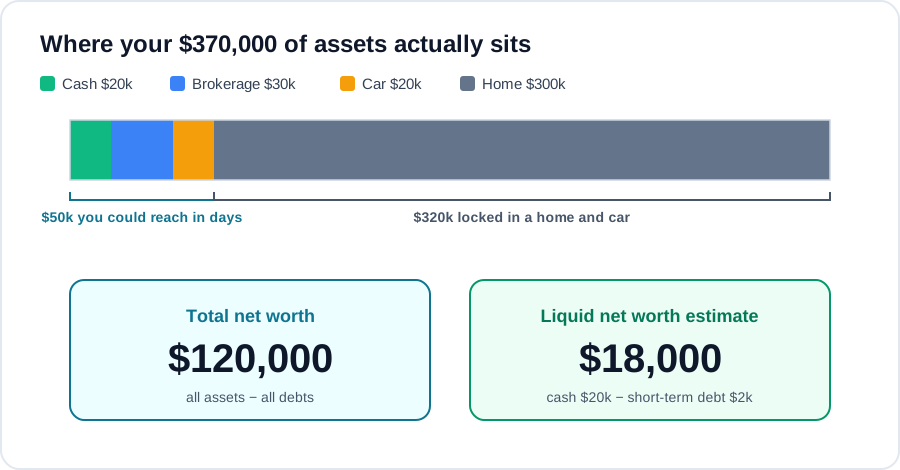
Here is the household behind the $120,000-vs-$18,000 headline. The assets total $370,000 and the debts total $250,000.
| Item | Amount | Liquid? |
|---|---|---|
| Checking | $4,000 | Yes |
| Savings | $16,000 | Yes |
| Taxable brokerage | $30,000 | Investable, not cash |
| Home value | $300,000 | No |
| Car value | $20,000 | No |
| Mortgage | −$240,000 | — |
| Auto loan | −$8,000 | — |
| Credit card debt | −$2,000 | Short-term |
The two numbers come out very differently:
- Total net worth = $370,000 − $250,000 = $120,000.
- Liquid assets = $4,000 + $16,000 = $20,000 (the brokerage is invested, not cash).
- Liquid net worth estimate = $20,000 − $2,000 short-term debt = $18,000.
So $72,000 of the total is home and car equity ($60,000 + $12,000) that you cannot easily spend, and another $30,000 sits invested. The honest picture is a healthy balance sheet with a thin cash cushion — not a pile of spendable money.
Why liquid net worth matters
Liquid wealth is what gets you through the moments that actually test a budget: a layoff, a medical bill, a car that dies, or a chance to move. The Consumer Financial Protection Bureau’s guide to building an emergency fund frames this directly: readily available savings are what keep a surprise expense from becoming high-interest debt. A large total net worth does not help on the day the bill is due if it is all tied up in a house. That is the whole reason to track liquid net worth alongside the total — not instead of it.
How Worth101 shows total, liquid, and investable separately
Instead of one number, the calculator reports three. Total net worth is every asset minus every debt. The liquid net worth estimate is cash-like assets minus short-term debt. Investable assets are the balances already in investment and retirement accounts. Seeing all three keeps you from confusing a strong long-term position with short-term flexibility — and it is why the tool does not pretend home equity is instantly spendable. If you are unsure which line items belong in the total, start with the net worth asset-and-debt checklist.
Frequently asked questions
What is liquid net worth?
Liquid net worth is the cash and bank balances you can access quickly, minus short-term, high-interest debt. It is usually much smaller than total net worth, which also includes a home, car, and retirement accounts you cannot easily spend.
Is a brokerage account liquid net worth?
It depends on the definition. Stocks and ETFs can be sold within days, so some sources count a taxable brokerage as liquid. Worth101 treats it as an investable asset instead, because it is invested, can fall in value, and may trigger capital-gains tax when sold.
Can liquid net worth be negative?
Yes — if your short-term debt is larger than your cash. Under definitions that subtract all debt, including the mortgage, even a wealthy household can show a negative liquid net worth. That is one reason Worth101 uses the narrower short-term-debt view.
How do I improve my liquid net worth?
Build cash savings and pay down high-interest short-term debt; both move the number up directly. Selling a home or car can raise cash, but it also removes the asset, so it is rarely a simple liquidity fix.
What to read next
This article is educational and is not financial advice. Examples use rounded, illustrative values; the liquid net worth estimate is a planning figure, not a guarantee of how much you could access without taxes, penalties, or selling costs.