

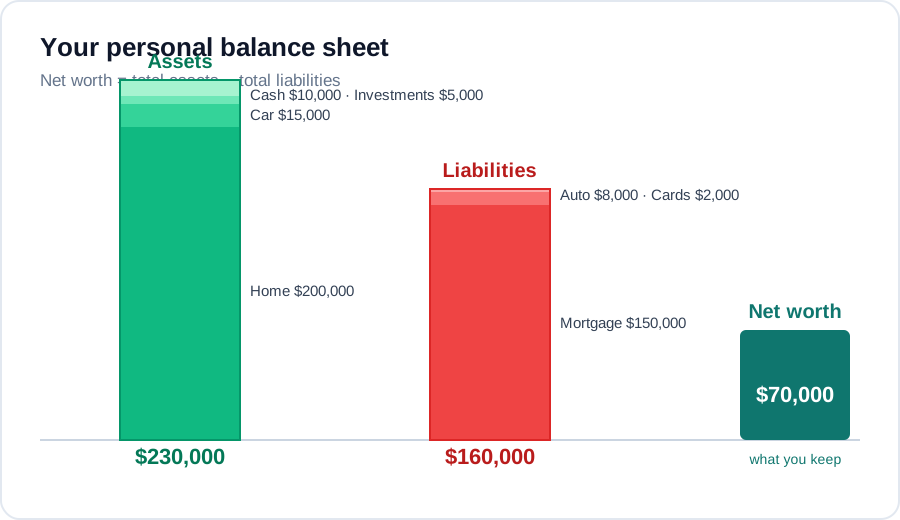
Net worth is the value of everything you own minus everything you owe. If your assets are worth $230,000 and your debts total $160,000, your net worth is $70,000. It is a single number that captures your financial position at one point in time — a snapshot of your personal balance sheet, not a measure of how much you earn. Income is the money that flows in each month; net worth is what you have actually kept and built up after debts.
This guide covers the net worth formula, what counts as an asset and a liability, a full worked example, and why your total net worth is useful but not the same as the money you can actually spend today.
The net worth formula
The formula is the simplest idea in personal finance. Add up what you own, subtract what you owe, and the difference is your net worth:
Your net worth can be positive (you own more than you owe), zero (they cancel out), or negative (your debts are larger than your assets). All three are normal at different stages of life, and the number naturally changes every time you save, invest, pay down debt, or an asset rises or falls in value.
A quick net worth example
Here is a typical household snapshot. The left side lists assets, the right side lists debts, and the bottom row is the result.
| Assets (what you own) | Value | Liabilities (what you owe) | Balance |
|---|---|---|---|
| Cash and savings | $10,000 | Mortgage | $150,000 |
| Investments | $5,000 | Auto loan | $8,000 |
| Home value | $200,000 | Credit card debt | $2,000 |
| Car value | $15,000 | ||
| Total assets | $230,000 | Total liabilities | $160,000 |
| Net worth | $230,000 − $160,000 = $70,000 | ||
What counts as an asset
An asset is anything you own that has real, sellable value. The most common ones are:
- Cash and bank accounts — checking, savings, money market, and CDs.
- Investments and retirement accounts — a taxable brokerage account, plus a 401(k), IRA, Roth IRA, or HSA.
- Property — your home, a car, other real estate, and business ownership.
For a complete, practical checklist of what to include — and what to leave out — see what counts toward net worth. If you are deciding whether a specific item belongs on the asset side or the liability side, use the examples in assets vs. liabilities.
What counts as a liability
A liability is any balance you still have to repay. The usual ones are a mortgage, an auto loan, student loans, credit card balances, personal loans, and medical debt. You use the current payoff balance, not the original loan amount. A mortgage you have paid down to $150,000 counts as $150,000, even if you originally borrowed $250,000.
How to calculate your net worth, step by step
- List every asset and its current value (today’s estimate, not what you paid).
- Add them up to get your total assets — $230,000 in the example above.
- List every debt and its current payoff balance.
- Add them up to get your total liabilities — $160,000 above.
- Subtract liabilities from assets. $230,000 − $160,000 = $70,000.
That is your net worth. Doing it once tells you where you stand; doing it every few months turns it into a progress tracker, because the trend matters far more than any single snapshot.
Why net worth matters
Net worth is the one number that ties your whole financial life together. A raise feels good, but it only builds wealth if it shows up on your balance sheet. Tracking net worth over time answers the question budgets cannot: are you actually getting ahead? It is also the standard measure economists use — the Federal Reserve’s Survey of Consumer Finances defines family wealth as exactly this: assets minus liabilities.
Net worth is not the same as income
A large salary does not guarantee a large net worth. Two people earning $150,000 can have completely different balance sheets: one saves and invests steadily, the other spends it all and carries debt. Income measures the flow of money through your life; net worth measures what is left after that flow. This is why net worth vs. income is one of the most useful distinctions in personal finance — and why a high earner can still have a negative net worth.
Why total net worth is not always usable wealth
Here is the part most definitions skip. In the example, $70,000 looks like spendable money, but most of it is not. The home equity ($200,000 value − $150,000 mortgage = $50,000) is locked inside the house. You cannot pay a surprise bill with it unless you sell or borrow against the home. The same is true of a car and of retirement accounts you cannot touch without penalties.
That is why it helps to look at wealth in three layers:
- Total net worth — every asset minus every debt ($70,000 here).
- Liquid net worth — cash and bank balances you can reach quickly, minus short-term debt. See liquid net worth vs. total net worth.
- Investable net worth — the part already in investment and retirement accounts that can grow over time. That narrower slice is what the investable net worth guide focuses on.
The Worth101 net worth calculator separates these three on purpose, because a strong total net worth and a thin cash cushion are two very different situations. The exact formulas for each layer are documented in the methodology of how Worth101 calculates net worth.
Common net worth mistakes
Using the price you paid instead of today’s value
A car you bought for $30,000 might be worth $15,000 now. Always use the current estimated value, or your net worth will be inflated by thousands of dollars.
Double counting your home or car
Either list the full home value ($200,000) as an asset and the mortgage ($150,000) as a separate liability, or list only the equity ($50,000). Do not do both — that double counts and overstates your net worth.
Inflating personal belongings
Furniture, clothes, and gadgets rarely have meaningful resale value. Counting them at “replacement cost” quietly pads your net worth with money you could never realize.
Frequently asked questions
What is a good net worth?
There is no single number, because it depends on your age, income, and goals. A more useful approach is to compare your net worth to your own past — is the trend rising? — and, if you want context, to median benchmarks by age group rather than to the wealthiest households. See average vs. median net worth by age.
Should I include my house in my net worth?
Yes. Home equity — your home’s value minus the mortgage balance — is part of total net worth. Just remember it is not liquid: you generally cannot spend it without selling or borrowing. The Worth101 calculator lets you toggle home equity on or off so you can see your net worth both ways.
Do retirement accounts count toward net worth?
Yes. A 401(k), IRA, Roth IRA, or HSA balance is an asset and counts toward total net worth at its current value. Keep in mind a traditional 401(k) is pre-tax, so the balance is not the same as the after-tax amount you could actually spend in retirement.
How often should I calculate my net worth?
Once a quarter is plenty for most people. Checking monthly can make normal market swings feel stressful, while once a year can hide problems for too long. The goal is to watch the trend, not to react to every move.
What to read next
This article is educational and is not financial advice. Net worth examples use rounded, illustrative values and current estimated asset prices; they do not account for taxes owed on selling assets or withdrawing from retirement accounts.