

Assets are what you own. Liabilities are what you owe. Net worth is the difference: assets minus liabilities. The hard part is not the formula; it is classifying real-life items correctly without double-counting your house, overvaluing your car, or treating future income like money you already have.
The Federal Reserve's household balance sheet uses the same basic framing: household net worth equals assets less liabilities. This guide turns that idea into a personal balance sheet you can actually use.
Assets vs liabilities: quick definition
An asset is something you own that has economic value. The CFPB glossary defines an asset as an item with economic value, such as stock or real estate. A liability is a debt or balance you still need to repay.
| Item | Asset or liability? | Why |
|---|---|---|
| Checking account | Asset | Cash you own |
| 401(k) | Asset | Investment account value |
| House | Asset | Market value of property |
| Mortgage | Liability | Debt secured by the home |
| Car | Asset | Resale value |
| Car loan | Liability | Amount still owed |
| Credit card balance | Liability | Debt owed |
| Student loan | Liability | Debt owed |
| Furniture | Usually ignore or discount | Hard to sell at meaningful value |
Common examples of assets
For a personal net worth calculation, the most common assets are:
- Cash and bank accounts — checking, savings, money market funds, and CDs.
- Investments — taxable brokerage accounts, stocks, bonds, ETFs, mutual funds, and crypto if you track it conservatively.
- Retirement accounts — 401(k), IRA, Roth IRA, 403(b), 457(b), and HSA balances.
- Property — home value, car resale value, business ownership, and valuable collectibles with a real market.
If you want the item-by-item checklist version, read what counts toward net worth. This article focuses on the classification problem: asset or liability?
Common examples of liabilities
Liabilities are the balances that reduce your net worth:
- Credit card balances
- Student loans
- Mortgage balance
- Car loan
- Personal loans
- Medical debt
- Home equity line of credit balance
- Unpaid taxes or other bills you already owe
Use the current payoff balance, not the original loan amount. If you borrowed $30,000 for a car and now owe $14,000, the liability is $14,000.
Common confusing cases
- House: the house is an asset, but the mortgage is a liability. Count both separately or count only home equity; do not count the full house value and forget the mortgage.
- Car: the car is an asset at resale value, but it usually depreciates. The car loan is a liability.
- Retirement account: it is an asset, but not the same as liquid cash. Taxes, account rules, and penalties can affect what you can spend.
- Credit card limit: not an asset. It is borrowing capacity, not money you own.
- Salary: not an asset in your current net worth. Pay becomes an asset only after you receive and keep it.
- Rent: usually not a liability unless you already owe unpaid rent.
- Student loan and degree: the loan is a liability. The degree may raise earning power, but you usually do not list it as a dollar-valued asset.
- Personal belongings: technically assets if sellable, but most furniture, clothing, and electronics should be heavily discounted or ignored.
Personal balance sheet example
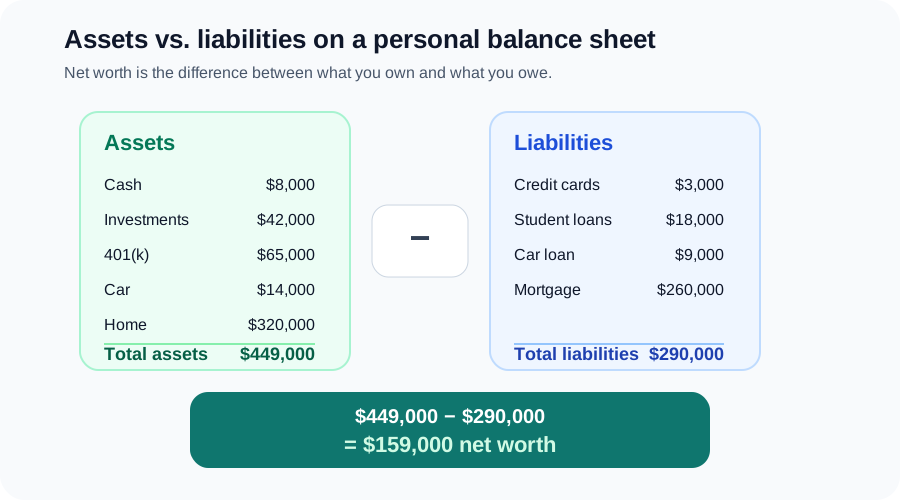
A personal balance sheet puts assets on one side and liabilities on the other. Here is a realistic example:
| Assets | Value |
|---|---|
| Cash | $8,000 |
| Investments | $42,000 |
| 401(k) | $65,000 |
| Car | $14,000 |
| Home | $320,000 |
| Total assets | $449,000 |
| Liabilities | Balance |
|---|---|
| Credit cards | $3,000 |
| Student loans | $18,000 |
| Car loan | $9,000 |
| Mortgage | $260,000 |
| Total liabilities | $290,000 |
This person has positive net worth, but much of it is home equity and retirement money. The cash they can use quickly is much lower than $159,000. That is why the next layer matters.
Not all assets are equally usable
Net worth is a big-picture number. It does not tell you whether your wealth is liquid, locked in a home, invested for retirement, or tied up in a depreciating car.
| Type | Includes | Why it matters |
|---|---|---|
| Total net worth | Home, car, retirement, cash, investments | Big-picture wealth |
| Liquid net worth | Cash, taxable investments, maybe near-cash assets | Emergency flexibility |
| Investable net worth | Portfolio assets usable for growth or income | Planning and compounding |
For a deeper split, read liquid net worth vs. total net worth and investable net worth.
Asset or liability? A quick decision tree
Is it an asset? Ask:
- Do you own it?
- Can it be valued in dollars?
- Could it realistically be sold, transferred, or used?
- Should it be counted at full value, discounted value, or ignored?
Is it a liability? Ask:
- Do you owe money to someone?
- Is there an outstanding balance?
- Is it legally or practically required to be repaid?
- Does it reduce your financial resources?
FAQ
Is a house an asset or liability?
A house is an asset at its current market value. The mortgage attached to the house is a liability. Your home equity is the difference between the two.
Is a car an asset or liability?
A car is an asset at realistic resale value. A car loan is a liability. Because cars often lose value, use a conservative number rather than the original purchase price.
Is a mortgage a liability?
Yes. A mortgage is a liability because it is a debt you still owe. In net worth, list the home value as an asset and the remaining mortgage balance as a liability, or list only home equity.
Is income an asset?
Future income is not an asset in your current net worth. Once you receive income and keep it as cash, investments, or another owned item, that retained amount becomes an asset.
Are retirement accounts assets?
Yes. A 401(k), IRA, Roth IRA, or similar retirement account is an asset. Just remember that some balances may not be fully spendable today because of taxes, age rules, or account restrictions.
Are credit cards liabilities?
A credit card balance is a liability. A credit limit is not an asset because it is the ability to borrow, not money you own.
What to read next
Bottom line
Assets increase net worth. Liabilities reduce it. The useful habit is to classify each item honestly, value it conservatively, and keep total, liquid, and investable wealth separate in your mind. That gives you a cleaner picture than a single big number ever could.