

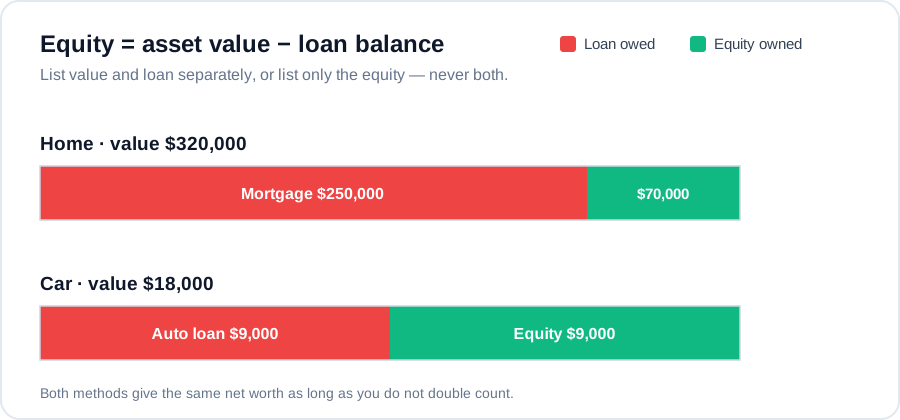
Net worth counts every meaningful asset you own and every debt you owe. Assets include cash, savings, investments, retirement accounts, your home value, your vehicle value, and valuable property. Liabilities include credit card debt, student loans, auto loans, mortgages, personal loans, medical bills, and other balances you must repay. For a home or car, you can either list the full market value and the loan separately, or list just the equity — as long as you never count both.
This is the practical checklist article. If you just need the formula, start with what is net worth. Below, we go item by item so you know exactly what to include, how to value it, and where people get it wrong. If your main question is whether something is an asset or a liability, start with assets vs. liabilities.
Common assets to include
Include anything you own that has real, sellable value:
- Cash and bank accounts — checking, savings, money market, and CDs.
- Taxable investments — a brokerage account holding stocks, bonds, ETFs, or mutual funds.
- Retirement accounts — 401(k), traditional IRA, Roth IRA, and an HSA if you invest it.
- Home value — the current market value of your primary residence.
- Vehicle value — what your car would realistically sell for today.
- Business ownership — only at a realistic, conservative valuation.
- Valuable collectibles — only if they have a genuine resale market.
Common liabilities to include
Include every balance you still owe, at its current payoff amount:
- Credit card debt
- Mortgage balance
- Home equity line of credit (HELOC) balance
- Auto loan
- Student loans
- Personal loans
- Medical debt
- Buy-now-pay-later balances, if meaningful
- Unpaid taxes you owe
How to treat your home
Your home is usually the largest item on the balance sheet, so getting it right matters. You have two valid options:
- Value-and-loan method: list the full home value as an asset and the mortgage balance as a separate liability.
- Equity method: list only your home equity, which is the value minus the mortgage.
Both give the same net worth. The one thing you cannot do is count the full value as an assetand forget to subtract the mortgage — that overstates your wealth by the entire loan balance.
How to treat your car
A car counts toward net worth at its current resale value, not the price you paid. Use a realistic estimate — a private-sale or trade-in figure — and subtract any auto loan. A $18,000 car with a $9,000 loan adds $9,000 of equity. Remember that vehicles usually lose value over time, so this number tends to drift down even as you pay the loan off.
How to treat retirement accounts
A 401(k), IRA, Roth IRA, or HSA counts toward net worth at its current balance. One important nuance: a traditional 401(k) or traditional IRA is usually pre-tax, so the balance you see is larger than the amount you could actually spend after income tax in retirement. IRS pension and annuity distribution guidance covers how taxable retirement distributions are reported. A Roth IRA is funded with after-tax contributions, though Roth withdrawal tax treatment still depends on the account rules. Net worth still uses the current balance for both, but it is worth knowing that a $65,000 traditional 401(k) is not $65,000 of spendable money. Those balances are also a big part of your investable net worth, because they are the slice already working in the markets.
How to treat personal property
Furniture, electronics, clothing, and most household goods are where net worth calculations go wrong. They lose value the moment you buy them and rarely have a real resale market. As a rule, only include personal property that you could genuinely sell for a meaningful amount — jewelry, a high-value watch, or collectibles with an active market. Even then, use a conservative resale figure, not replacement cost. When in doubt, leave it out; a slightly lower net worth is better than a fictional one.
What not to overcount
- Everyday belongings at “what they would cost to replace.” Use resale value or skip them.
- A business at an optimistic valuation. If you cannot realistically sell it for that price, do not book it.
- Future income — a bonus you have not received or a pension you have not started is not a current asset.
- The full home value without subtracting the mortgage (the most common double-count).
A full net worth checklist example
Here is a complete household. Notice the assets and the debts are each totaled before subtracting.
| Assets | Value | Liabilities | Balance |
|---|---|---|---|
| Checking and savings | $18,000 | Mortgage | $250,000 |
| Brokerage account | $22,000 | Auto loan | $9,000 |
| 401(k) | $65,000 | Credit card debt | $3,000 |
| Home value | $320,000 | Student loan | $12,000 |
| Car value | $18,000 | ||
| Total assets | $443,000 | Total liabilities | $274,000 |
| Net worth | $443,000 − $274,000 = $169,000 | ||
The same household using the equity method would list home equity of $70,000 ($320,000 − $250,000) and car equity of $9,000 ($18,000 − $9,000) instead of the full values and their loans. Either way, net worth is $169,000.
Quick “count it?” reference
| Item | Count it? | How to value it | Common mistake |
|---|---|---|---|
| Home | Yes | Market value − mortgage | Forgetting to subtract the loan |
| Car | Yes | Resale value − auto loan | Using the purchase price |
| 401(k) / IRA | Yes | Current balance | Ignoring it is pre-tax |
| Furniture / electronics | Usually no | Resale value only | Counting replacement cost |
| Business | If realistic | Conservative sale value | Optimistic valuation |
| Credit cards / loans | Yes (as debt) | Current payoff balance | Leaving out small balances |
How to enter these items into the calculator
The Worth101 net worth calculator groups inputs the same way this article does: cash and bank accounts, investments and retirement, property and physical assets, and debts. For your home and car, you enter the value and the loan in their own fields, and the tool subtracts them as a pair — turn off the “include home equity” toggle and it removes the home value and the mortgage together, so the total stays correct. The full set of categories and rules is in the net worth methodology.
Frequently asked questions
Does your house count toward net worth?
Yes. Your home counts as an asset and the mortgage counts as a liability, so the part that adds to net worth is your equity — value minus the loan. A $320,000 home with a $250,000 mortgage adds $70,000.
Does your car count toward net worth?
Yes, at its current resale value minus any auto loan. Because cars depreciate, this figure usually falls over time, which is why it is treated separately from investments that are meant to grow.
Does a 401(k) count toward net worth?
Yes. Retirement accounts are assets and count at their current balance. Just remember a traditional 401(k) is pre-tax, so the spendable, after-tax amount is lower than the balance shown.
Should I include furniture and personal belongings?
Generally no. Most household goods have little resale value, and counting them at replacement cost inflates your net worth. Include only items with a genuine resale market, valued conservatively. The difference between total and liquid net worth explains why padding the total with hard-to-sell items is misleading.
What to read next
This article is educational and is not financial advice. Examples use rounded, illustrative values and current estimated prices; they do not model taxes owed on selling assets or withdrawing from retirement accounts.