

Negative net worth means your total debts are larger than your total assets. If you own $15,000 of assets and owe $56,000, your net worth is -$41,000. It usually comes from ordinary causes — student loans, an auto loan, credit card balances, or medical bills — and it is especially common early in a career. Most importantly, it is not permanent. Net worth is a snapshot, and tracking it over time shows real progress as debts fall and savings grow.
If the basics are new to you, see what is net worth first. This article is about what a negative number actually means and how to move it in the right direction, without judgment.
The formula, and a simple example
The math is the same as always — assets minus liabilities — it just lands below zero:
| Assets | Value | Liabilities | Balance |
|---|---|---|---|
| Cash | $2,000 | Student loan | $42,000 |
| Car value | $9,000 | Auto loan | $11,000 |
| Retirement account | $4,000 | Credit card debt | $3,000 |
| Total assets | $15,000 | Total liabilities | $56,000 |
| Net worth | $15,000 − $56,000 = -$41,000 | ||
Common reasons net worth is negative
- Student loans that arrive before the salary they paid for.
- An auto loan larger than the car is now worth.
- Credit card or medical debt from an unexpected expense.
- A new mortgage in the early years, before you have built much equity.
None of these are character flaws. They are the normal mechanics of borrowing to invest in education, transportation, or a home before the asset side of the balance sheet has caught up.
Why negative net worth is common early in life
For many people, the early-career years are when debts are largest and assets are smallest. That pattern shows up in national data: in the Federal Reserve’s 2022 Survey of Consumer Finances, the median net worth for families under age 35 was about $39,000 — far below older age groups — and a meaningful share of younger households are below zero entirely. A negative number at 25 or 30 says much more about where you are in the timeline than about your financial future. For the full age-band table, see average vs. median net worth by age.
Why reaching zero is real progress
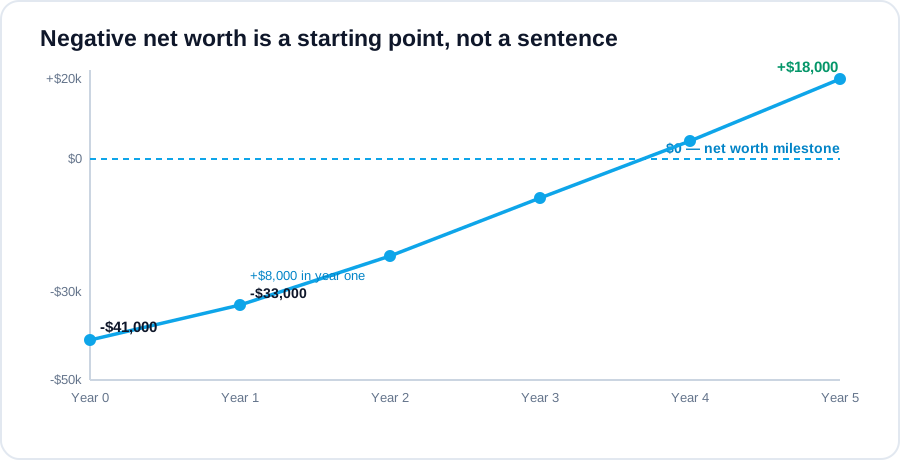
It is easy to fixate on a big positive goal and overlook the most important milestone: getting to $0. Climbing from -$41,000 to $0 is a $41,000 improvement — the same size of move as going from $0 to +$41,000. Every payment that shrinks a balance and every dollar you save moves the number up. The line below shows how steady progress can look over a few years.
How to improve a negative net worth
There are only two levers, and both move the number the same direction: shrink what you owe and grow what you own. A simple, concrete example: if you pay down $6,000 of debt and add $2,000 to savings over time, your net worth improves by $8,000 — from -$41,000 to -$33,000 — assuming your asset values hold steady. Practical ways to pull those levers include:
- Prioritize the highest-interest debt (often credit cards) so less of each payment is lost to interest.
- Build a small cash buffer so a surprise expense does not become new debt.
- Capture any employer 401(k) match you are eligible for — it adds to the asset side when you contribute enough to receive it.
- Avoid taking on new depreciating debt while you are climbing out.
This is general education, not a recommendation of any specific loan, consolidation, or product. The right sequence depends on your interest rates, income, and goals.
What to track each month or quarter
You do not need a complex system. Tracking three things is enough to see the trend:
- Total debt (is it falling?)
- Total savings and investments (are they rising?)
- Net worth (the gap between them, moving toward zero and beyond)
Frequently asked questions
What does negative net worth mean?
It means your debts add up to more than your assets. If you owe $56,000 and own $15,000, your net worth is -$41,000. It is a snapshot of one moment, not a measure of your income or your long-term prospects.
Is negative net worth bad?
It is common, especially in your 20s and early 30s when student loans and a new car or mortgage outweigh early savings. What matters more than the sign is the direction: a number that is steadily improving is a healthy sign, even while it is still below zero.
How long does it take to get to a positive net worth?
It depends entirely on your debt size, interest rates, and how much you can save. There is no universal timeline. The useful habit is to measure the trend every quarter so you can see the gap closing.
Can you have a high income and negative net worth?
Yes. Income and net worth are different things — see net worth vs. income. A high earner with large loans and little savings can have a negative net worth, while a moderate earner who saves steadily can be well into positive territory.
What to read next
This article is educational and is not financial advice. Examples use rounded, illustrative values and assume asset prices hold steady; they do not account for interest, taxes, or changes in the value of a car or home over time.