

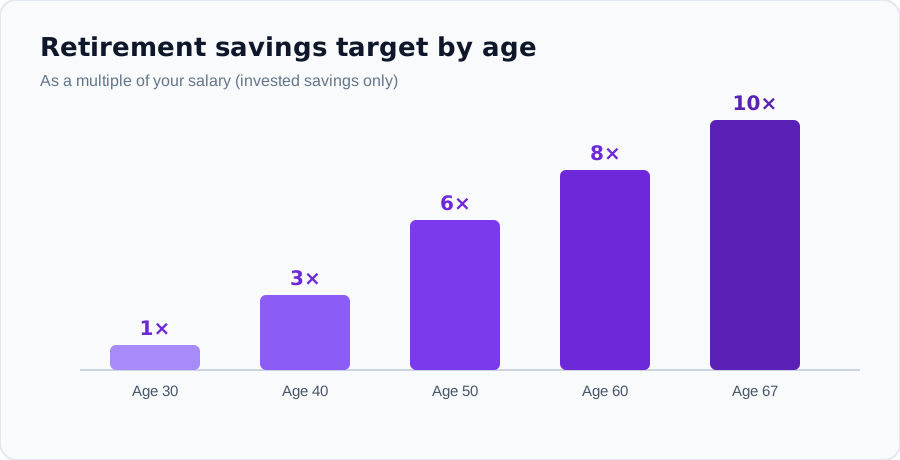
A fast way to check if you are on pace is to measure your retirement savings as a multiple of your salary. A widely used rule of thumb: aim for about 1× your salary saved by 30, 3× by 40, 6× by 50, and 8× by 60, reaching roughly 10× by 67. On an $80,000 salary, that means about $80,000 by 30 and around $480,000 by 50. These are retirement-account targets — your 401(k), IRA, and other invested savings — not a measure of your total household wealth.
Salary multiples are a quick gut-check, not a personal answer. They assume you’ll replace a similar share of income in retirement and lean on Social Security for the rest. Below are the targets by age, the savings rate that gets you there, and how to catch up if you’re behind.
Savings targets by age
Here are the salary-multiple checkpoints, with the dollar amount they imply on an $80,000 salary. The multiples are one common rule of thumb used by retirement providers; treat them as a rough pace, not a precise requirement or official standard.
| Age | Target (× salary) | On an $80,000 salary |
|---|---|---|
| 30 | 1× | $80,000 |
| 40 | 3× | $240,000 |
| 50 | 6× | $480,000 |
| 60 | 8× | $640,000 |
| 67 | 10× | $800,000 |
These are retirement savings milestones — money in invested accounts meant to produce future income. They are deliberately different from a net worth figure, which also includes home equity, cars, and cash, and from average net worth by age benchmarks. Two households with identical net worth can be in very different shape for retirement depending on how much of it is actually invested for income.
The savings rate behind the targets
Hitting roughly 10× salary by 67 generally takes saving around 15% of gross income each year — including any employer 401(k) match — invested for growth and started in your twenties or early thirties. Start later and the required rate climbs, because you lose years of compounding. Maxing tax-advantaged accounts helps: for 2026 the 401(k) employee contribution limit is $24,500 and the IRA limit is $7,500, with additional catch-up contributions allowed once you turn 50.
What to do if you’re behind
- Capture the full employer match first. It is an immediate return on contributions and the fastest way to lift your savings rate.
- Use catch-up contributions. From age 50 the IRS lets you contribute extra to 401(k) and IRA accounts — designed for exactly this situation.
- Raise the rate with every pay bump. Routing raises into savings lifts your percentage without feeling like a cut.
- Remember Social Security and a later retirement. Working a few more years and delaying your claim both shrink the target — being “behind” on multiples is not the same as being unable to retire.
Frequently asked questions
Is this the same as net worth by age?
No. These multiples measure invested retirement savings, while net worth includes your home, vehicles, and cash minus debts. You can have a healthy net worth and still be behind on retirement savings if most of it is tied up in your house.
What if I don’t have a 401(k) match?
Aim for a similar 15% total savings rate using an IRA and a taxable brokerage account. The accounts differ in tax treatment, but the pace target is the same.
Can I still retire if I’m behind at 50?
Often yes. Catch-up contributions, a higher savings rate, a slightly later retirement age, and Social Security can close a surprising amount of ground in 15–17 years. Run your own numbers to see the real gap rather than relying on a benchmark.
What to read next
This article is educational and not financial advice. Salary-multiple targets are general benchmarks; your real requirement depends on your spending, Social Security, and retirement age. Verify current contribution limits with the IRS before acting.