

If you invest $10,000 and add $500 per month at a 7% annual return, your money could grow to about $106,600 in 10 years, $300,900 in 20 years, and $691,200 in 30 years. That example assumes monthly compounding, contributions at the end of each month, and no taxes, fees, inflation, or market volatility.
The answer depends on four inputs: your starting amount, your monthly contribution, how long you let the money grow, and the return rate you assume. The Compound Interest Calculator lets you use your own numbers; this guide gives you fast reference points before you start adjusting sliders.
Quick examples: how much your money could grow
All four examples below use a 7% annual return with monthly compounding. They are hypothetical illustrations, not promises about any investment.
| Scenario | 5 years | 10 years | 20 years | 30 years |
|---|---|---|---|---|
| $1,000, no monthly contribution | $1,418 | $2,010 | $4,039 | $8,116 |
| $10,000 + $100/month | $21,336 | $37,405 | $92,480 | $203,162 |
| $10,000 + $500/month | $49,973 | $106,639 | $300,851 | $691,150 |
| $0 + $500/month | $35,796 | $86,542 | $260,463 | $609,985 |
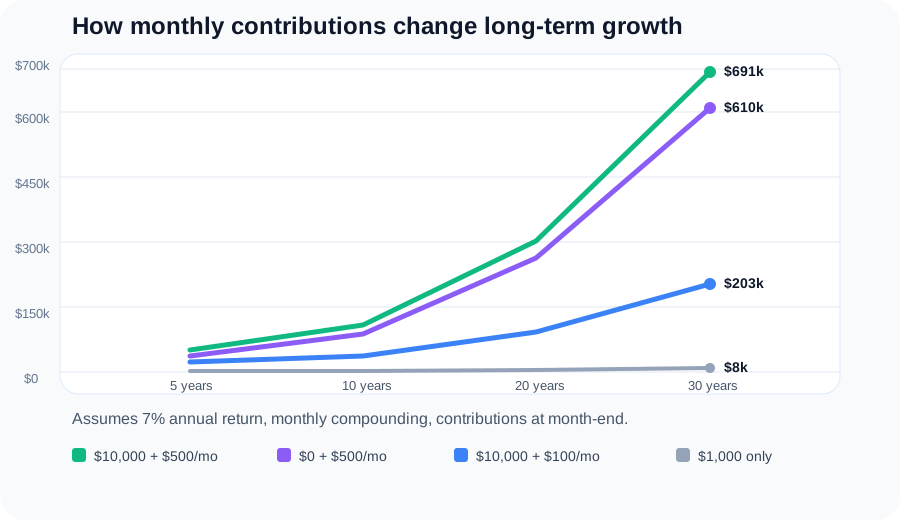
Investor.gov, run by the U.S. Securities and Exchange Commission, frames this exact question as how much money can grow through compound interest and lets users enter an initial investment, monthly contribution, years, interest rate, and compounding frequency in its compound interest calculator. Worth101 uses the same core variables, then turns common scenarios into readable examples.
Example 1: $1,000 invested once
A one-time $1,000 investment at 7% grows to about $2,010 in 10 years and $8,116 in 30 years. That is useful for understanding compounding, but it also shows the limit of a small lump sum. Time helps, but the base amount is still modest.
Example 2: $10,000 plus $100 per month
Starting with $10,000 and adding $100 per month reaches about $37,405 in 10 years and $203,162 in 30 years. You would contribute $46,000 total over 30 years: $10,000 upfront plus $36,000 from monthly deposits. The rest is growth from compounding.
Example 3: $10,000 plus $500 per month
This is the main saver scenario. With $10,000 upfront and $500 per month, the 30-year result is about $691,150 at 7%. You contribute $190,000 total, and the remaining roughly $501,000 is return. That gap is why small monthly habits can become large future balances when you give them decades.
Which matters more: starting money or monthly contributions?
Starting money matters because it gets more years to compound. But over long timelines, monthly contributions often do more work than people expect.
| Starting amount | Monthly contribution | 30-year result at 7% |
|---|---|---|
| $10,000 | $0 | ~$81,200 |
| $0 | $100 | ~$122,000 |
| $10,000 | $100 | ~$203,200 |
| $10,000 | $500 | ~$691,200 |
| $50,000 | $500 | ~$1,015,800 |
The lesson is not that starting money is irrelevant. It is that a repeatable contribution habit can outrun a one-time head start. A $0 starting balance with $100 per month beats $10,000 with no monthly contribution over 30 years in this example.
How much difference does the return rate make?
The assumed return rate changes the answer dramatically. For $10,000 upfront plus $500 per month for 30 years, here is the range:
| Annual return | Ending balance | How to read it |
|---|---|---|
| 3% | ~$315,900 | More conservative, closer to cash/bond-style planning |
| 5% | ~$460,800 | Moderate long-term assumption |
| 7% | ~$691,200 | Common stock-heavy planning baseline |
| 10% | ~$1,328,600 | Higher upside, higher uncertainty |
Higher assumed returns are not free money. They usually mean more volatility, a wider range of possible outcomes, and more risk that the next decade looks different from the last one. If you want to compare returns in today's purchasing power, read real vs. nominal return.
Why the Rule of 72 is not enough when you add money monthly
The Rule of 72 is great mental math for one lump sum. Divide 72 by the annual return to estimate how long a balance might take to double. At 7%, that is about 10.3 years.
But the shortcut does not handle monthly contributions well. If you add $500 every month, each deposit has a different amount of time to grow. That is why a calculator is more useful for the question “how much will my money grow if I keep adding to it?”
FAQ
How much will $10,000 grow in 10 years?
At a 7% annual return with monthly compounding and no added contributions, $10,000 grows to about $20,100 in 10 years before taxes, fees, inflation, and market volatility.
How much will $500 a month grow to in 30 years?
At a 7% annual return with monthly compounding, $500 per month grows to about $610,000 in 30 years. You would contribute $180,000; the rest would come from compound growth in this hypothetical example.
Does compound interest include monthly contributions?
Compound interest can apply to a lump sum alone or to a balance that receives monthly contributions. When monthly contributions are included, each new deposit starts earning its own future growth.
What return rate should I assume?
Use a conservative range instead of one perfect number. Testing 3%, 5%, 7%, and 10% helps you see how sensitive the result is. For goals that must happen on schedule, plan with lower returns and treat higher returns as upside.
What to read next
Bottom line
Your money grows from the combination of time, contributions, and return. A bigger starting balance helps, but a monthly habit often matters more over 20 or 30 years. Use the examples above for orientation, then run your own numbers before making a plan.