

Net worth generally rises with age, but average and median net worth tell very different stories. Using the latest available Federal Reserve Survey of Consumer Finances data — from the 2022 survey — the median net worth for US families under 35 was about $39,000, while the average (mean) was about $183,500. The average is pulled upward by a small number of very wealthy households, so the median usually gives a better picture of a typical household. This article shows both numbers by age group and explains how to use them without treating them as a personal scorecard.
Data note: Figures are family (household) net worth in 2022 dollars from the Federal Reserve’s 2022 Survey of Consumer Finances, the most recent completed SCF. The Federal Reserve began the 2025 survey in February 2025 and expects summary results in late 2026; this article will be refreshed when they are released.
Average vs. median, in plain English
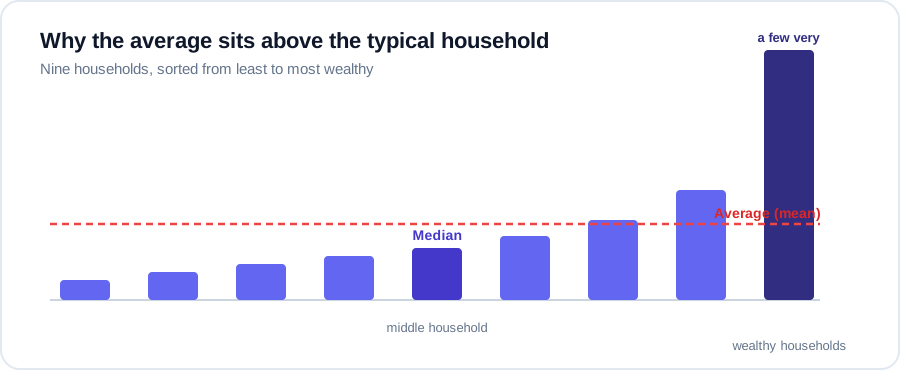
The average (or mean) adds up everyone’s net worth and divides by the number of households. The median is the middle household — half of families are above it and half are below. When a small number of households hold enormous wealth, they drag the average far above the middle, while the median barely moves. That is exactly what happens with net worth.
Net worth by age: the table
Here are the median and average figures by age of the head of household, in 2022 dollars. Notice how much larger the average is than the median in every age band.
| Age of head of household | Median net worth | Average net worth |
|---|---|---|
| Under 35 | $39,000 | $183,500 |
| 35–44 | $135,600 | $549,600 |
| 45–54 | $247,200 | $975,800 |
| 55–64 | $364,500 | $1,566,900 |
| 65–74 | $409,900 | $1,794,600 |
| 75 or older | $335,600 | $1,624,100 |
Source: Federal Reserve Survey of Consumer Finances, 2022 (family net worth by age of reference person, in 2022 dollars).
Net worth by age: the chart
The same numbers as a chart make the gap obvious — the average bars tower over the median bars, and both climb with age until they level off in retirement.
US net worth by age: median vs. average (2022 dollars)
Why the average is so much higher than the median
Wealth in the US is highly concentrated. A relatively small group of households holds a large share of total wealth, and their balances are big enough to lift the national average well above what a typical family has. For the 55–64 group, the average ($1,566,900) is more than four times the median ($364,500). Whenever you see a headline “average net worth” figure, assume it is higher than what most households actually have — the median is the more grounded benchmark.
Why net worth usually rises with age
The upward trend through middle age is mostly mechanical: people have had more years to pay down debt, build home equity, and let retirement accounts grow. The slight dip after age 74 in the data reflects retirees spending down savings. None of this means a 30-year-old is “behind” a 60-year-old — they are simply at different points on the same long timeline, which is why a negative or small net worth early on is so common.
Why these benchmarks are imperfect
Age benchmarks are a rough reference, not a target. They average over enormous differences in income history, location, cost of living, student debt, homeownership, family size, and career path. A renter in a high-cost city and a homeowner in a low-cost town can be doing equally well with very different net worth figures. The numbers are also household-level — a couple and a single person are counted differently — so comparing your individual net worth to a family figure is not apples to apples.
How to use benchmarks without overreacting
- Compare against the median, not the average, for a typical-household view.
- Treat the band as a wide reference range, not a pass/fail line.
- Watch your own trend over time — that is far more useful than any single comparison.
- Remember the figures are household-level and in 2022 dollars.
How to calculate and track your own net worth
Your own number matters more than any benchmark. Start with what is net worth for the formula, use the net worth calculator to add it all up, and recheck it each quarter. The Worth101 calculator also includes an optional benchmark that compares your total net worth to these same SCF figures by age band, and the methodology page documents exactly how the benchmark is sourced.
Frequently asked questions
What is the average net worth by age in the US?
From the 2022 Survey of Consumer Finances, average family net worth was about $183,500 under 35, $549,600 for ages 35–44, $975,800 for 45–54, $1,566,900 for 55–64, $1,794,600 for 65–74, and $1,624,100 for 75 and older — all in 2022 dollars. These averages are pulled up by the wealthiest households.
Is median or average net worth more useful?
For comparing yourself to a typical household, the median is more useful because it is not distorted by a small number of very wealthy families. The average is still informative, but it sits well above what most households actually have.
Are these figures per household or per person?
They are household (family) figures from the Federal Reserve, grouped by the age of the head of household. A couple’s combined net worth is counted as one household, so they are not the same as individual net worth.
Is there newer net worth data for 2026?
Not yet. The 2022 survey is the most recent completed SCF. The Federal Reserve began the 2025 survey in early 2025 and expects summary results in late 2026, so the 2022 figures remain the latest available benchmark until then.
What to read next
This article is educational and is not financial advice. Figures are household net worth in 2022 dollars from the Federal Reserve Survey of Consumer Finances and are reference points, not personal targets.