

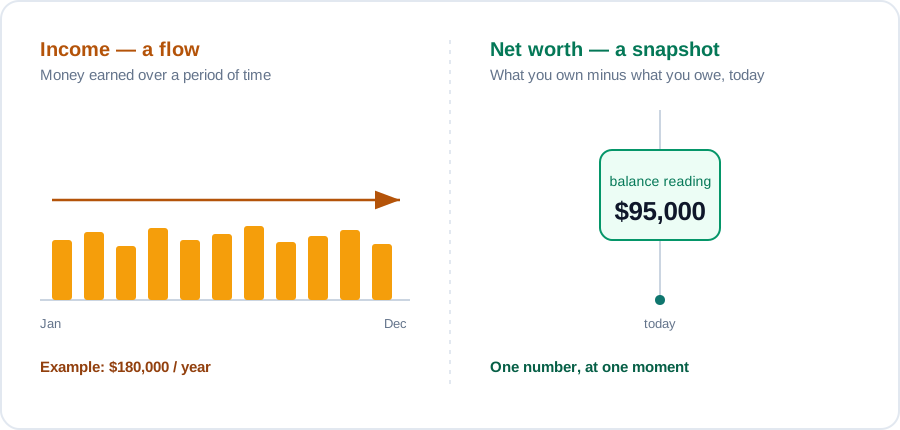
Income is the money you earn over a period of time. Net worth is what you own minus what you owe at a single point in time. A high income can help you build wealth, but it does not guarantee it: if spending and debt rise just as fast as the paycheck, net worth barely moves. A person earning $180,000 can have a net worth of -$15,000, while someone earning $65,000 who saves steadily can be sitting on $95,000. The two numbers measure completely different things.
If you want the underlying formula first, see what is net worth. Here, we focus on why salary and wealth are not the same — and why net worth is often the more honest scorecard.
Income is a flow
Income is a flow: it is measured across time, like $6,000 a month or $72,000 a year. It tells you how much money moves through your hands, not how much stays. Two people with the same salary can end the year in completely different places depending on what they did with that flow.
Net worth is a snapshot
Net worth is a stock, or a snapshot: it is measured at one moment, like a photo of your finances taken today. It is the running total of everything your income, saving, investing, and borrowing have added up to so far. Income is the river; net worth is the reservoir.
Two people, two very different balance sheets
This is the clearest way to see the gap. Person A out-earns Person B almost three to one, yet Person B is far wealthier.
| Person A | Person B | |
|---|---|---|
| Annual income | $180,000 | $65,000 |
| Assets | $40,000 | $115,000 |
| Debts | $55,000 | $20,000 |
| Net worth | -$15,000 | $95,000 |
Person A: high income, low net worth
Person A earns $180,000 but spends nearly all of it, carries $55,000 in debt, and has saved little. Their balance sheet is negative despite a six-figure salary. A negative number here is not a crisis — see negative net worth — but it shows that a big paycheck alone does not build wealth.
Person B: moderate income, higher net worth
Person B earns $65,000, lives below their means, keeps debt low, and has steadily built $115,000 of assets. Less money flowed in, but more of it stayed and turned into wealth.
Why both numbers matter
This is not an argument that income does not matter — it absolutely does, because income is the raw material wealth is built from. A higher income makes it possible to save and invest more. The point is that income is potential and net worth is the result. The bridge between them is your savings rate: the share of income you keep and put to work each year.
Why net worth often reveals progress better than income
A raise feels like progress, but it only counts if it lands on your balance sheet. Net worth captures the full picture income misses: debt you are paying down, investments that are growing, and savings you are building. That is why tracking net worth over time is such a useful habit — it answers the question a paycheck cannot: are you actually getting ahead?
How income becomes net worth
The mechanism is simple: the income you save and invest becomes assets, and those invested assets can grow on their own through compounding. A modest, steady amount of saved income can turn into a large invested balance over time — you can see that math in the compound interest calculator, and what is compound interest explains why time matters so much. The salary sets the ceiling; the savings rate decides how close you get to it.
Frequently asked questions
What is the difference between net worth and income?
Income is money earned over a period, such as a month or a year. Net worth is the value of everything you own minus everything you owe at one point in time. One is a flow; the other is a snapshot of the result.
Can you have a high income and a low net worth?
Yes, and it is common. High spending and high debt can keep net worth low — even negative — no matter how large the paycheck. The deciding factor is how much of your income you keep and invest.
Which matters more, net worth or income?
They measure different things, so both matter. Income creates the opportunity to build wealth; net worth shows whether that opportunity has translated into actual assets. For tracking long-term financial health, net worth is usually the more revealing number.
How do I turn a good income into net worth?
Spend less than you earn, keep high-interest debt low, and invest the difference so it can grow. The saved portion of your income becomes assets, and those assets compound over time.
What to read next
This article is educational and is not financial advice. Examples use rounded, illustrative values to compare income and net worth and do not reflect any specific individual.