

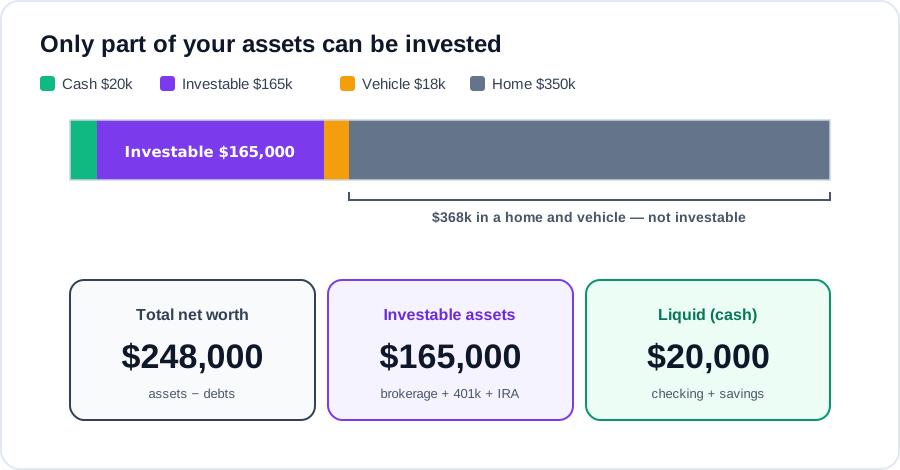
Investable net worth is the part of your wealth already sitting in investment and retirement accounts — a taxable brokerage, a 401(k), an IRA, a Roth IRA, an HSA, and similar balances that can grow, compound, or produce income. It usually excludes your home, your car, and personal belongings. Total net worth tells you what you own minus what you owe; investable net worth zooms in on the slice that can actually build future wealth in the markets. In the example below, a household with a $248,000 total net worth has $165,000 of investable assets.
New to the basics? Start with what is net worth, then come back — this article builds on it.
What counts as an investable asset
Investable assets are the balances that are invested or meant to be invested:
- Taxable brokerage accounts (stocks, bonds, ETFs, mutual funds)
- 401(k) and similar workplace plans
- Traditional IRA and Roth IRA
- HSA, when you invest it rather than spend it
- Other retirement accounts
- Crypto and alternative holdings, at current value
What usually does not count
- Your primary residence — valuable, but not an investable financial asset unless you sell or borrow against it.
- Your car — a depreciating, personal-use asset.
- Furniture and personal property
- Cash in checking and savings — this is liquid, not yet investable. You could invest it, but until it is in an investment account, Worth101 counts it as liquid.
How Worth101 defines investable assets
Definitions vary by financial institution. Some report “investable assets” without subtracting any debt; others use “investable net worth” to mean investable assets minus certain debts. Worth101 keeps it simple and transparent: the investable assets estimate is the sum of your investment and retirement balances, with no debt subtracted. It is an estimate of what is working in the markets for you, not an after-tax or after-debt figure. The exact rule lives in the Worth101 methodology.
Example calculation
Here is a household with assets totaling $553,000 and debts of $305,000.
| Item | Amount | Investable? |
|---|---|---|
| Cash (checking + savings) | $20,000 | Liquid, not yet invested |
| Taxable brokerage | $50,000 | Yes |
| 401(k) | $90,000 | Yes |
| IRA | $25,000 | Yes |
| Home value | $350,000 | No |
| Vehicle value | $18,000 | No |
| Mortgage / credit card / student loan | −$305,000 | — |
- Total net worth = $553,000 − $305,000 = $248,000.
- Investable assets = $50,000 + $90,000 + $25,000 = $165,000.
- The home ($350,000) and vehicle ($18,000) are part of total net worth but are not investable.
If you prefer a definition that subtracts non-mortgage debts from investable assets, you would net out the $5,000 credit card and $20,000 student loan to get $140,000. Worth101 reports the $165,000 asset figure and lets you see your debts separately, so you can interpret it either way without the tool hiding anything.
Investable net worth vs. total net worth
Total net worth includes everything you own. Investable net worth strips out the home, the car, and other personal-use assets to show the wealth that can compound. The gap matters because two households with the same $248,000 total net worth can be in very different positions: one with $165,000 invested and a modest home, another with $20,000 invested and most of its wealth locked in real estate.
Investable net worth vs. liquid net worth
These two are easy to confuse. Liquid wealth is cash you can spend this week. Investable wealth is money already invested for the long term — sellable, but meant to grow, and sometimes locked behind retirement rules or capital-gains taxes. Cash you intend to invest is liquid today and becomes investable once you actually buy investments. See liquid net worth vs. total net worth for the full comparison.
Why investable net worth matters for long-term planning
Investable assets are the engine of long-term wealth, because they are the part that can compound. The same $165,000 left to grow at a historical-style return adds up very differently over decades than cash in a checking account — you can model that in the compound interest calculator, and what is compound interest explains why. Just keep the layers straight: growth happens on the investable slice, not on home equity or a car.
Investable assets are not a FIRE number
If you are planning for financial independence, your investable assets matter more than your total net worth — but they are still not the same as a FIRE target. A FIRE number is based on your annual spending and a safe withdrawal rate, and it generally counts only the assets you will actually draw from, not your primary home. You can see the difference in the FIRE Number Calculator. The point here is narrow: investable net worth describes what you own that can grow, not how much you need to retire.
Frequently asked questions
What are investable assets?
Investable assets are balances that are invested or can be invested to grow — brokerage accounts, 401(k)s, IRAs, an invested HSA, and similar holdings. They typically exclude your home, car, and personal property.
How is investable net worth different from net worth?
Total net worth counts every asset minus every debt. Investable net worth counts only the assets that can grow in the markets, so it is usually smaller — especially for homeowners, whose net worth often leans heavily on home equity.
Does cash count as an investable asset?
Worth101 treats cash in checking and savings as liquid rather than investable, because it is not yet invested. Once you move it into a brokerage or retirement account, it becomes part of your investable assets.
Is my home an investable asset?
No. A primary residence is valuable and counts toward total net worth, but it is not investable in this sense — you cannot put it to work in the markets without selling or borrowing against it.
What to read next
This article is educational and is not financial advice. Examples use rounded, illustrative values. Investable assets are shown before taxes; a traditional 401(k) or IRA balance is usually pre-tax and is not the same as its after-tax, spendable value.