

Simple interest earns only on your original principal. Compound interest earns on principal plus the interest already added. That one difference is why they barely separate at first and then split wide apart. Put $5,000 at 7% for 30 years and simple interest gives you $15,500, while compound interest reaches $38,061 — more than double, on the exact same deposit.
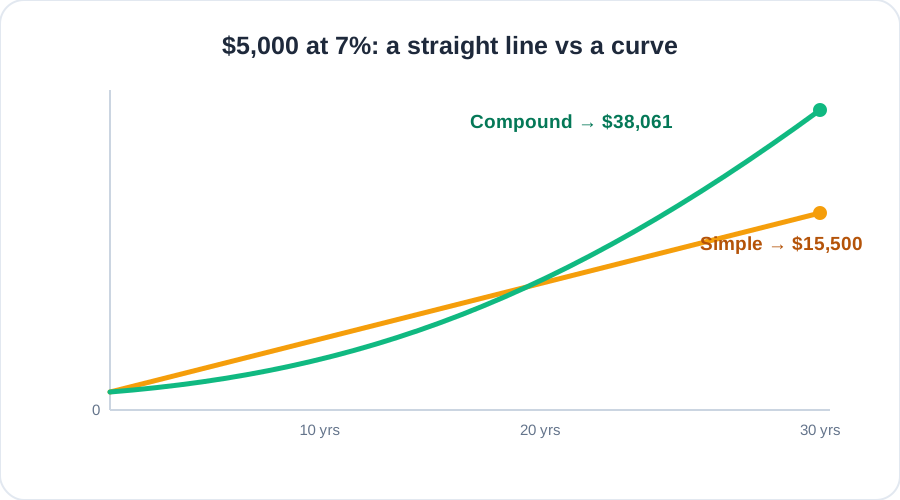
| Years | Simple interest | Compound interest | Difference |
|---|---|---|---|
| 5 | $6,750 | $7,013 | $263 |
| 10 | $8,500 | $9,836 | $1,336 |
| 20 | $12,000 | $19,348 | $7,348 |
| 30 | $15,500 | $38,061 | $22,561 |
$5,000 at 7% (annual compounding, no monthly additions) — set years to 30 to land on $38,061:
Compare $5,000 at 7% over time
Approximate; annual compounding and monthly contributions.
What is simple interest?
Simple interest is calculated only on the original principal, the same dollar amount every period. The formula is short:
On $5,000 at 7%, that is $350 of interest every year — never more, because the interest never joins the principal. After 30 years you have collected $10,500 in interest for a $15,500 balance. Predictable and flat.
What is compound interest?
Compound interest adds each period's interest back to the balance, so the next period's interest is calculated on a bigger number. Year one earns $350; by year 30 a single year earns far more, because it is earning on roughly $38,000 instead of $5,000. For the full mechanics, see what is compound interest and the compound interest formula.
Simple vs compound interest: side by side
| Simple interest | Compound interest | |
|---|---|---|
| Interest earns on | Principal only | Principal + accumulated interest |
| Growth shape | Straight line | Upward curve |
| Formula | P × r × t | P(1 + r/n)nt |
| Good for you when | You are borrowing | You are saving or investing |
| Common examples | Many car loans, some personal loans | Index funds, savings, credit-card balances |
When simple interest helps you
As a borrower, a simple-interest structure can be friendlier when the rate, fees, and term are otherwise comparable. Interest is calculated on the outstanding principal rather than added to principal on a regular compounding schedule. Many auto loans and some personal loans use this structure, which is why an extra principal payment can reduce later interest.
When compound interest helps you
As a saver or investor, compound interest is the engine. Every dollar of return starts earning its own return, so the back half of a long horizon does most of the work. In the table above, years 20–30 alone add about $18,700 of compound growth — more than the entire first 20 years. That is why starting early beats trying to catch up later, a point the Rule of 72 makes vivid by counting doublings.
Borrowing vs investing: the two-edged sword
Compound interest is not automatically “good.” It is simply powerful in whichever direction it points. Working for you in an index fund, it builds wealth. Working against you on a credit-card balance — where interest typically compounds daily — it can outrun your payments. The same force that turns $5,000 into $38,061 can turn a carried balance into a debt that grows faster than you expect.
Common mistakes
1. Assuming the two are close. Over 5 years they nearly match ($263 apart). Over 30 years compound wins by $22,561 on the same $5,000. The gap is all in the time.
2. Forgetting compounding cuts both ways. Celebrating compound growth on investments while carrying a compounding credit-card balance can quietly cancel the win.
3. Comparing a simple-interest loan rate to a compound APY. They are measured differently — see APY vs interest rate before you decide which offer is cheaper.
Frequently asked questions
What is the difference between simple and compound interest?
Simple interest is calculated only on the original principal, so it grows in a straight line. Compound interest is calculated on principal plus previously earned interest, so it curves upward and pulls ahead over time.
Can you give a simple vs compound interest example?
At 7% on $5,000 for 30 years, simple interest produces $15,500 while compound interest produces $38,061 — a $22,561 difference from the same starting deposit.
Is compound interest always better than simple interest?
Not always. Compounding helps when returns stay invested, but it works against you on debt. For loans, compare the APR, fees, term, payment schedule, and whether unpaid interest can be capitalized rather than judging the product by the interest label alone.
Do loans use simple or compound interest?
It depends on the product. Many car loans and some personal loans use simple interest on the balance, while credit cards typically compound. Always check how a specific loan calculates interest.
What to read next
Examples assume annual compounding and a fixed 7% rate with no withdrawals; actual rates and loan terms vary. This article is educational and does not constitute financial advice.