

APY includes compounding; the interest rate does not. The interest rate is the plain annual rate a bank pays or charges. APY (annual percentage yield) rolls in how often that interest compounds, so it is higher when a positive rate compounds more than once a year. A 5% rate compounded monthly works out to a 5.12% APY — same account, two slightly different numbers. Knowing which is which keeps you from entering the wrong figure in a calculator or misreading a savings ad.
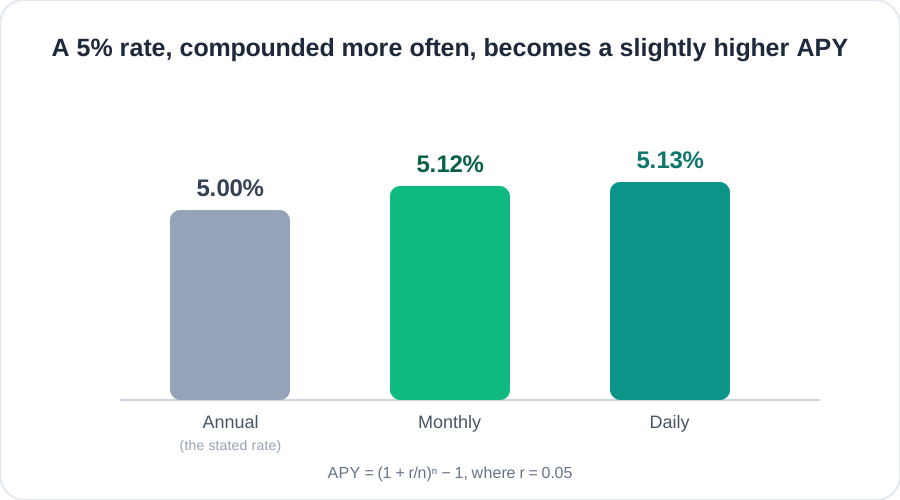
| 5% rate compounded… | APY | Interest on $10,000 (1 yr) |
|---|---|---|
| Annually | 5.00% | $500 |
| Monthly | 5.12% | $512 |
| Daily | 5.13% | $513 |
What is an interest rate?
The interest rate (sometimes called the nominal rate) is the headline annual percentage on an account or loan, before any compounding is counted. If a savings account pays a 5% rate and you deposit $10,000, you would earn exactly $500 in a year if interest were paid just once at year-end. The catch: most accounts pay interest monthly or daily, so the rate alone understates what you actually receive.
What is APY?
APY — annual percentage yield — is the rate after compounding. It answers the only question that matters when comparing accounts: “how much will $100 actually become in a year?” Because it already accounts for monthly or daily compounding, APY is the apples-to-apples number. Under Regulation DD's advertising rules, a deposit-account ad that states a rate of return must state it as APY. The interest rate may appear too, but not more prominently.
The APY formula
Here r is the nominal annual rate (as a decimal) and n is the number of compounding periods per year. For a 5% rate compounded monthly:
- r = 0.05, n = 12
- (1 + 0.05/12)12 − 1 = 0.0512
- APY = 5.12%
Compound it daily instead and the APY edges up to 5.13%. The gap between monthly and daily is tiny — about $1 a year on $10,000 — which is why compounding frequency rarely decides anything on its own.
APY vs interest rate: the simple difference
| Interest rate | APY | |
|---|---|---|
| Includes compounding? | No | Yes |
| Always the higher number? | No | Yes (when compounding more than once a year) |
| Where you see it | Loan notes, the math formula | Savings and CD ads |
| Best for comparing accounts? | No | Yes |
Should you enter APY or the interest rate into a calculator?
This trips up a lot of people. The indexed compound interest scenario applies its own compounding, so the editable calculator expects the nominal annual rate, not the APY. If your bank only advertises an APY and you type it in and let the tool compound monthly, you double-count compounding and overstate your result.
The practical shortcut: if the difference matters to you, enter the rate and set compounding to match the account. If you only have the APY and want a quick estimate, entering the APY with annual compounding gets you within a rounding error — because an APY already is the annual-equivalent yield. To see why frequency barely moves the result, the compound interest formula walks through the same 5% example at every frequency.
APY vs APR
APR (annual percentage rate) is the borrowing-side cousin. It expresses borrowing cost as a yearly rate, but what it includes depends on the product: mortgage APR includes certain finance charges, while a credit-card APR generally does not include fees. APR also does not express the effect of intra-year compounding. Rule of thumb: compare deposit accounts by APY and borrowing products by APR, then check the fees and terms behind either number.
Why savings APYs move with the Fed
Deposit APYs are not fixed features of an account; they often move with broader market rates, including the Federal Reserve's policy rate. As of June 15, 2026, the Fed's target range was 3.50%–3.75% after its January, March, and April 2026 decisions.
The spread between accounts can be large. The FDIC national average for savings accounts was 0.38% APY as of May 18, 2026. That national average is not a quote for every bank, so compare current APYs, minimum balances, fees, and account terms before choosing an account. Treat any specific APY as a dated snapshot, not a permanent 30-year return assumption.
Common mistakes
1. Comparing an APY to a rate. One bank's “4.9% rate” can beat another's “5.0% APY” once you convert both to the same basis. Always compare APY to APY.
2. Feeding an APY into a calculator that also compounds. That double-counts. Use the nominal rate, or pair the APY with annual compounding.
3. Treating a savings APY as a long-term return. A competitive savings APY reflects the current rate environment and can change. For long-horizon growth, use an assumption that matches the asset and risk you are modeling — see real vs nominal return.
Frequently asked questions
What is the difference between APY and interest rate?
The interest rate is the plain annual rate before compounding; APY is the rate after compounding is applied. For a positive rate, APY is equal to or higher than the stated rate, and it is the better number for comparing savings accounts.
How do you convert an interest rate to APY?
Use APY = (1 + r/n)n − 1, where r is the decimal rate and n is the number of compounding periods per year. A 5% rate compounded monthly gives a 5.12% APY.
Is APY the same as APR?
No. APY measures what you earn on savings and includes compounding. APR measures the cost of borrowing and, in its basic form, does not show intra-year compounding. You want a high APY and a low APR.
Should I use APY or the rate in a compound interest calculator?
Enter the nominal interest rate and let the calculator handle compounding. If you only have the APY, pair it with annual compounding for a close estimate, since an APY is already an annual-equivalent yield.
What to read next
Rates cited reflect mid-2026 conditions and change over time; verify current figures before acting. This article is educational and does not constitute financial advice.